..a thought!
Thursday, April 26, 2012

Wednesday, October 1, 2008
Confidence

Kheir-Eddin al-Zarkali recalled in his book 'the Arabian peninsula in the era of King Abdulaziz," that one day king abdulaziz smiled when he was meeting with Sheikh Noori al-Shalaan, the leader of the tribes of al-Rola. Later, King Abdulaziz told Noori that those who are sitting near you were my enemies. Noori replied: it was your sword, but King Abdulaziz added 'no it was not the sword, but I respected them and treated them like members of al-Saud."
Saturday, January 5, 2008
One of Rowala's Sayings
 “Qara” here is a little town located on the southern-west of Skaka city at Aljouf region. Whereas “manda” describes the act of shepherd gathering and leading his herd of camels outside the drinking place.
Its meaning is equivalent to the popular saying “Don't count your chickens before they're hatched”.
I will post its story soon.
Wednesday, January 2, 2008

Readings from Mercury's Sandals: The Jews and other nomads.Chapter 1.
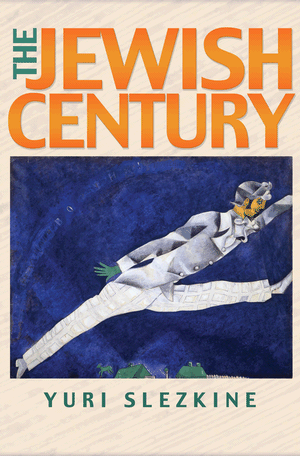
For the Rwala [Bedouin], wealth, in terms of camels, goods, and gold, could not be conserved; it had to be converted into reputation (or honor). For the peripatetics service nomads, most of whom were emissaries from the towns, and all of whom were regarded as such, rightly or wrongly, by the Rwala, wealth is measured by possessions, be these objects or cash. Among
the Rwala, to be rich in possessions implied a lack of generosity, which led to a diminution of honor, and in turn, a decrease in influence.
the Rwala, to be rich in possessions implied a lack of generosity, which led to a diminution of honor, and in turn, a decrease in influence.
Friday, August 3, 2007
Rwala Bedouin

This article is written by Jamie Zehnder,Sept. 1999 .
Almost all Bedouin are Arabic speaking and practice the Muslim religion. According to custom, a Bedouins grave is marked with simplicity, placing one ordinary stone at the head of the grave and one at its foot. Tradition is to leave the clothes of the deceased atop the grave, to be adopted by whatever needy travelers pass by. The Bedouin political systems are, customarily, based on an extended patriarchal family unit. A sheik leads each unit, from a minor family to an entire tribe, the title descends from father to eldest son. The actual political authority of each sheik depends upon his wealth and the personality that he portrays. The four classifications of the Bedouin social system are based on ancestry and mobile wealth. For example, the camel breeders, the highest of this caste system, usually intermarry and consider other Bedouin groups inferior.
Bedouins also produce their own woolen clothing. Members often shave their heads, but all men wear beards. The most recognized aspect of a Bedouin’s attire is his headgear--which consists of the kaffia-cloth and 'agal-rope that constitute proper attire for a Bedouin man. The head rope shows the wearer's ability to abide by the obligations and responsibilities of manhood. Also signaling their status with their headgear all women are required to keep their hair covered. The fashion of the Bedouin woman are usually of black garment decorated on the chest, while their head and face are protected by a special cover called a bourque, along with expensive jewels.
The typical Bedouin tent is made from strips of cloth woven from goat or camel hair and vegetable fibers, sewn together and dyed black. A Bedouin tent is divided into two sections by a curtain which is woven known as a ma'nad. One section, for the men and for reception, is called the mag'ad, or 'sitting place.' The other, is called the maharama, or 'place of the women. Living in tents, makes it easy for the Bedouin to travel. These tents provide a place to sleep, to entertain guests, and also a place to prepare and eat food, primarily meat, milk, and dairy products provided by their herds.
Living in an unforgiving environment, any violation of territorial rights is viewed as severe. In Bedouin culture, trespassers are neither easily forgiven nor quickly forgotten. At the same time, the Bedouin culture notices the dangers and hardships of the desert. Bedouins have a profound sense of hospitality. In all the solitude, simply encountering another person is a rather unusual event. A new face is cause for celebration, feast, and festivity. All these encounters are depicted and seen in Bedouin poetry, sayings, and songs. These encounters give the Bedouin a chance to socialize and possibly hold trades. In certain cases various tribes may travel together; these tribes will organize camel races monthly or annually. The winner of the race is generally viewed with high respect.
Almost all Bedouin are Arabic speaking and practice the Muslim religion. According to custom, a Bedouins grave is marked with simplicity, placing one ordinary stone at the head of the grave and one at its foot. Tradition is to leave the clothes of the deceased atop the grave, to be adopted by whatever needy travelers pass by. The Bedouin political systems are, customarily, based on an extended patriarchal family unit. A sheik leads each unit, from a minor family to an entire tribe, the title descends from father to eldest son. The actual political authority of each sheik depends upon his wealth and the personality that he portrays. The four classifications of the Bedouin social system are based on ancestry and mobile wealth. For example, the camel breeders, the highest of this caste system, usually intermarry and consider other Bedouin groups inferior.
Bedouins also produce their own woolen clothing. Members often shave their heads, but all men wear beards. The most recognized aspect of a Bedouin’s attire is his headgear--which consists of the kaffia-cloth and 'agal-rope that constitute proper attire for a Bedouin man. The head rope shows the wearer's ability to abide by the obligations and responsibilities of manhood. Also signaling their status with their headgear all women are required to keep their hair covered. The fashion of the Bedouin woman are usually of black garment decorated on the chest, while their head and face are protected by a special cover called a bourque, along with expensive jewels.
The typical Bedouin tent is made from strips of cloth woven from goat or camel hair and vegetable fibers, sewn together and dyed black. A Bedouin tent is divided into two sections by a curtain which is woven known as a ma'nad. One section, for the men and for reception, is called the mag'ad, or 'sitting place.' The other, is called the maharama, or 'place of the women. Living in tents, makes it easy for the Bedouin to travel. These tents provide a place to sleep, to entertain guests, and also a place to prepare and eat food, primarily meat, milk, and dairy products provided by their herds.
Living in an unforgiving environment, any violation of territorial rights is viewed as severe. In Bedouin culture, trespassers are neither easily forgiven nor quickly forgotten. At the same time, the Bedouin culture notices the dangers and hardships of the desert. Bedouins have a profound sense of hospitality. In all the solitude, simply encountering another person is a rather unusual event. A new face is cause for celebration, feast, and festivity. All these encounters are depicted and seen in Bedouin poetry, sayings, and songs. These encounters give the Bedouin a chance to socialize and possibly hold trades. In certain cases various tribes may travel together; these tribes will organize camel races monthly or annually. The winner of the race is generally viewed with high respect.
Subscribe to:
Posts (Atom)


